
A fresh coat of green paint — Part 1: Mantle Climate
Consultant pitching environmentally friendly framing of data centres in Hamilton

image credit: W.carter, used under CC-BY-4.0 license
Screenshots of presentation slides shared with Blunder Valley suggest consultancy firm Mantle Climate has been hired by Slate Asset Management to pitch local non-profits and community organizations on a "green" framing of hyperscale data centres.
Slate, a multi-billion-dollar private equity firm, has repeatedly downplayed the nature and scale of its data centre ambitions to Hamilton residents. But as Blunder Valley recently uncovered, when Slate lobbied the federal government in November 2025, it pitched Hamilton as a potential "AI growth zone" with "800 MW estimated power capacity at full scale."
Additional documents, newly obtained via Access to Information request, show Slate lobbyists wrote to Housing, Infrastructure and Communities Canada in April 2026, requesting a meeting and describing their plans for the 800-acre site as "fully capitalized" and "development-ready".
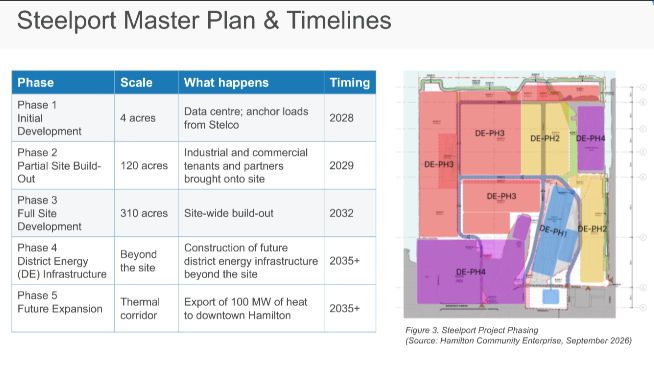
The screenshots from Mantle Climate's presentation show the consultancy promoting the idea that AI data centres on the old Stelco lands could supply "waste heat" to nearby buildings as part of a district energy system. One slide shows a chart of a phased development plan for a localized district energy system on the former Stelco lands. To the right of this chart is a map illustrating the development phases. The slide notes the map was provided by Hamilton Community Enterprises, a 100% municipally-owned corporation partnered with Slate.
The presentation claims that data centres could eventually provide heat to off-site downtown buildings and homes. But while the timeline targets 2028 for an active data centre, it also suggests that district energy infrastructure to supply downtown buildings would not be constructed until 2035 or beyond. The data centre boom is still young enough that it's not clear how long-lived many of the projects will be — particularly given how quickly the chips, and therefore the surrounding infrastructure, tend to become obsolete.
The map also raises multiple questions.
The only area explicitly shown as containing a potential data centre is an existing building previously identified by Slate as the potential site for a federally-backed AI data centre. That data centre was pitched to Council in July as being in the sub-20MW range. So it's not clear where Slate intends to get 100MW of "waste heat" — unless the size of the federally-backed AI datacentre is being wildly misrepresented, or the chart intentionally does not list other major data centre infrastructure planned for the site.
The boundaries of the development phases are different from any recent plans Slate has publicly put forward, and they don't seem to consider the severance application currently before the Ontario Land Tribunal. This suggests a party other than Slate may have hired Mantle Climate to create this presentation.
What is Mantle Climate?
Toronto-based Mantle Climate1, formerly Mantle Development, offers consultancy services such as analysis of embodied carbon in construction projects, and organizational climate risk assessments. Among the clients listed on their website are real estate investors, building materials producers, concrete and wood products companies, and several Canadian cities — including the City of Hamilton. Slate is not named as a client, although the list may not be current or exhaustive.
Rounding out the list: Ledcor, a massive company that has a green building arm, and which also builds oil & gas pipelines — and Texas-based Compass Datacenters, which operates facilities in the U.S., Canada, and Italy.
Compass also says it has built "several" data centres in Israel. And based on archived versions of their website, it appears Compass was the owner and operator of at least one Israeli data centre from around mid-January to October 2023. The company was bought in June 2023 for $5.5 billion by Brookfield and the Ontario Teachers' Pension Plan.2
Blunder Valley has made multiple attempts to contact Mantle via its website contact form, in the hopes of clarifying the status and nature of its current and previous relationships with the City of Hamilton, Slate, and Compass. Mantle has not responded to these inquiries. This story will be updated if a response is received.
Mantle's pro data-centre work has become something of a theme recently. In March 2026, Mantle and MaRS Discovery District co-authored a report titled "Sharing the Load", which looks at various potential scenarios for data-centre buildout over the next decade in Ontario, and how each might affect energy systems and carbon emissions.
The report proceeds from a baseline assumption that a massive amount of new AI compute infrastructure is necessary for Ontario and Canada's productivity and security — anywhere from 1.5–3 GW of new capacity by 2035. (Notably, even the high end of that range is only a fraction of the estimated 10 GW total connection requests already in the queue, according to Ontario's Ministry of Energy and Mines.)
The chart below shows the report's findings regarding the impacts of 1.5 GW of new data centre load by 2035, in a scenario where there is "greater adoption of mitigating solutions" by developers to lessen grid strain and greenhouse gas (GHG) emissions. The report concludes the use of natural gas power has no impact on GHG emissions, if a data centre company also pays for the buildout of renewables through Power Purchase Agreements (PPAs).
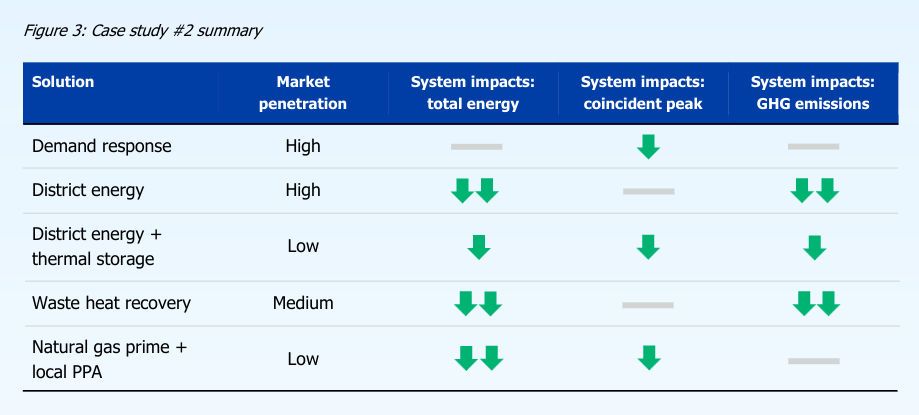
It's unclear how the authors reach this conclusion. Climate is affected by actual emissions and greenhouse gas concentration in our atmosphere, not accounting mechanisms — burning gas to power a new data centre represents an increase in CO2.
The argument that PPAs can somehow "offset" these new emissions might make some sense in a vacuum, but here in the real world, data centre energy demand is outpacing our ability to bring new renewables online. Until those renewables are operational, they can't "offset" anything.
Besides, if the urgent baseline need for the planet is for society to rapidly decarbonize, then every new gas plant and turbine deployed gets us further away from that goal, and results in a rise in atmospheric carbon. It's unconscionable for a self-described "climate" org to recommend building new fossil fuel infrastructure and/or downplay its harm.
Mantle and MaRS also co-authored an August 2026 op-ed in the Globe and Mail urging data centre proponents to find ways of getting local buy-in through providing "social and environmental benefits" to host communities.
There is barely a mention of climate or greenhouse gas emissions — although to its credit, the piece does recognize some of the many negative impacts routinely absorbed by places where data centres are built.
One of the proposed solutions: add more tech — the authors recommend data centre projects employ the services of climate-tech companies. They name-check seven companies with climate-tech products in various stages of development. All seven are directly linked to MaRS, whether through its incubator/accelerator programs or via funding/research partnerships. 3
And as if to say the quiet part out loud, in a November 2025 blogpost on the MaRS Discovery District website, there is a version of the "distracted boyfriend" meme in which "climate action" is ignoring "good intentions" and checking out "return on investment".
Part 2 will examine questions surrounding HCE's 2025 Energy Harvesting Study.
Notes
Mantle Climate's founder and CEO, Ryan Zizzo, is the brother of Laura Zizzo, founder of a similarly-named firm Manifest Climate, providers of an "AI-powered assessment engine for sustainability" software platform. Beyond the familial connection, the Zizzo siblings have an extensive history of business relationships. back
This meant quite a windfall for Compass' Israeli minority-owner Azrieli Group, which got a 2.5x return on the 20% ownership stake it had purchased in 2019, a little over two years prior. back
- Extract Energy: one of 10 "Mission from MaRS" companies;
- Enersion, Zs2: MaRS "Adaptech Accelerator" companies;
- Cura Climate: "Mission from MaRS" cohort 2;
- Cence Power: "Mission from MaRS" cohort 1;
- Peak Power: Mars "cleantech" startup;
- Jule: Funding/research partnership w/ MaRS
Thanks for reading. If you enjoyed this piece, please share it with those you think will be interested. And if you have a news tip about a data centre project, send me an email or find me on Signal.