
The Steelport AI data centre(s): what we know so far
Here's everything I've been able to dig up so far on the Steelport project in Hamilton, Ontario
Background
On March 2nd, Canada's National Observer reported on proposed data centres in Ontario that would total 2 gigawatts of new load on the electrical grid.
One of the reported data centre proposals is from Slate Asset Management, owners of the 800-acre former Stelco lands on Hamilton's waterfront, a site the company has branded "Steelport".
Slate's original 2025 application to Ontario's Independent Electricity System Operator (IESO) was for a 180 MW connection, and the request explicitly specified "data center" as the load type, according to my conversation with the journalists at the National Observer who broke the story.
Slate's connection request has since been updated to 400 MW, but no longer specifies a load type.
Into the weeds
There are two main issues:
-
The Digital Research Alliance of Canada (DRAC) has selected Steelport as the site for their bid to receive $705 million in federal funding to build an "AI supercomputer" data centre, as part of the feds' AI Sovereign Compute Infrastructure Program (AI SCIP).
If the site is selected by the government, the facility would be built by Slate, at which point the land and facility would be sold to DRAC, a non-profit funded by the federal government. - There are indications that Slate is also looking to build other (potentially much larger) data centre infrastructure at the Steelport site: not only did their original application to the IESO specify "data center" as the load type, but an April 8 presentation by Slate also suggests they are eager to build a hyperscale data centre on Hamilton's waterfront.
Regardless of what happens with either of these possible projects in the near term, my gut instinct at this point is that Hamiltonians need to push for one or both of:
- capping the size of data centres in our city - I'd suggest 1-megawatt as a potential starting point - and/or a moratorium on building data centres for a specified time period, e.g. 5 years;
- amendments to zoning by-laws to require special approvals for data centres above a certain power requirement.
Part 1: The DRAC data centre
We'll begin with the likely boondoggle of the DRAC data centre.
There has been very little transparency about this project's specifics. In response to a question about power consumption, Ward 4 Councillor Tammy Hwang provided me with an estimate of 8-10 MW, but noted this number was only to the best of her recollection.
Slate, although they have answered some of my questions about the project, has declined to say what the power draw of this facility would be. DRAC, meanwhile, has not yet responded to any of my questions or even acknowledged my emails, one sent on May 11th, and a follow-up on May 15th.
So, right now the best information I have is that the DRAC data centre would be an 8-10 MW facility, at a cost of $705 million.
The numbers don't add up
It's difficult to find a way to make these numbers work. According to an April 2026 piece in Canadian outlet The Logic:
"AI data centres can cost between $19.5 million to $33.5 million per megawatt, with most of that down to buying IT equipment, according to an October 2025 analysis by the federal innovation department."
Even if the DRAC project was at the highest cost in that range, that leaves $370 million to be accounted for, before adding in staffing, maintenance, and electricity.1
I've put the rest of the math in the footnotes, but here's the upshot: if this is a 10 MW data centre, then including the 7 years of operational budget the funding includes, my best estimate is that the total cost is just over $400 million.2
That would mean around $300 million in public funding is vanishing into thin air.
Or: maybe the data centre is much larger than the 8-10 MW estimate Councillor Hwang was given. This could explain where the $705 million in public funding is going, but on the other hand, a larger data centre is even more of a concern for Hamiltonians.
The DRAC data centre building
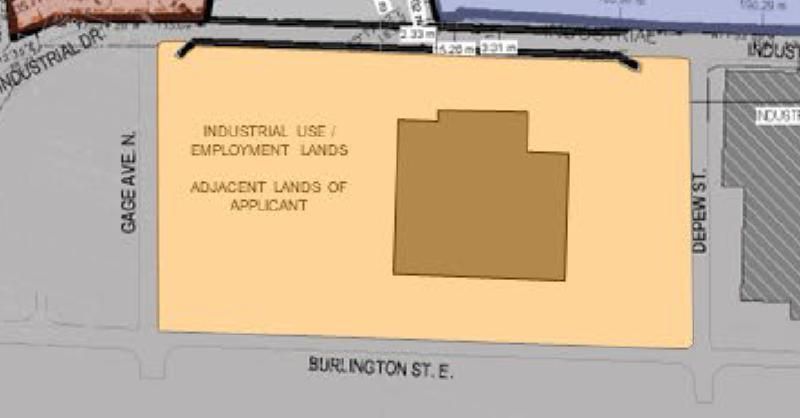
As shown in the presentation by Slate on April 8th, 2026, the proposed location of the DRAC facility is an 8-acre building located in the block between Industrial Drive & Burlington St East, and Gage Ave & Depew St. The existing building at that location looks to be roughly 8 acres.3 Slate declined to say if they plan on retrofitting the building or starting anew.
Importantly, the location is the part of the Steelport land closest to a residential neighbourhood - just 500-600 metres north of the nearest homes. I've asked DRAC what mitigations they would require to be put in place in terms of noise, heat island effects, etc. and will update this post if/when I receive a response.
Data centres are harming local grids
Data centres' voracious water and energy consumption are well-known (and I'll return to those aspects later), but there are other effects that have gone under-reported.
A 2024 Bloomberg investigation found a strong correlation between proximity to "significant data center activity" and grid power distortions that "can force home electronics to run hot, or even cause the motors in refrigerators and air conditioners to rattle". Furthermore, the authors write, "[t]he worse power quality gets, the more the risk increases. Sudden surges or sags in electrical supplies can lead to sparks and even home fires."
The cause of this isn't the electricity consumption itself, but how rapidly data centres switch large loads on and off. And they're hammering grids with these load spikes on such a regular basis that they may be causing neighbouring households "billions of dollars in total damage" to their appliances.
The piece goes on: "More than half of the tracked households showing the worst distortions of power quality are located within 20 miles of significant data center activity" - "significant data center activity" being defined as anything over 10 MW.
So, while a 10-megawatt data centre might sound small, even quaint, in an age of major tech corporations announcing gigawatt-scale data centres,4 these facilities are having all sorts of negative impacts on nearby households.
Besides, as already mentioned, there's the distinct possibility that the DRAC data centre would be much larger than the 8-10 MW estimate I was given.
Other externalities
Water & heat
The Hamilton Spectator recently reported that the facility is proposing to use evaporative cooling - which raises concerns about a heat island effect in the surrounding area (pdf).
The same article imples that the water for cooling would be pumped out of Lake Ontario. But data centres typically cannot use water containing live organisms, which causes biofilm build-up on equipment; they instead require potable water (in this case, likely from the municipal drinking water system).
According to Councillor Hwang, there is also legacy water treatment infrastructure at the Steelport site, but I haven't been able to confirm that it's in working condition, and Slate's slide deck doesn't mention it either. I've asked DRAC if they're looking at entering into any long-term agreements with Slate for water supply or any other service/resource - but as previously noted, I haven't yet received any response.
Noise
In terms of noise: my understanding is that noise impacts are definitely an issue over a radius that would impact a lot of people's homes, but I haven't yet dug deeply into that particular topic. Data centres tend to run at all hours of the day and night, though - and this building wouldn't even be the only source of bothersome all-night hum affecting residents in this part of the city.
Data protection
Lastly - the supposed reason the feds would giving DRAC $705m for this project is to create "sovereign AI infrastructure", ostensibly because we don't want to be processing Canadians' sensitive data on US servers. Well, Slate Asset Management has billions of dollars invested in US real estate, a situation that is easily leveraged by the US to undermine the security of this facility. Whether or not we think the data centre is a good idea: is this the company we want in charge of building it?
But wait, this data centre is for research - That's good, right?
I asked myself the same question. And I think the answer depends on what kind of "AI" we're talking about here - because "AI" is, ultimately, a marketing term that's being used to describe a number of very different kinds of computational systems.
Machine Learning (ML), for example, has been around for decades, and there are plenty of use cases where it functions reliably and usefully. Protein folding simulations are one example. Early voice-to-text transcription software is another. A lot of ML applications can easily be run on a home PC, or a couple of computers in a company's IT department.
Recently though, we've seen an explosion in more computationally intensive systems, including Large Language Models (LLMs) like ChatGPT, Claude, and Gemini. Barely a day goes by without a new story of how unreliable - and even dangerous - these systems are. Here are two recent examples that hit close to home:
- On May 13 reports emerged that an LLM, intended for use by Ontario doctors as a transcription tool, was found to be generating "incorrect, incomplete and hallucinated information", including suggesting therapies that the doctor had not even mentioned.
- In March, McMaster University research fellow and guest teacher Kémy Adé had her permanent residence application rejected after an LLM, used by the government in processing the application, invented a job description that didn't match her (real) stated work experience.
In fact, large language models are causing so many problems in the scientific research community that the widely used open-access academic preprint site ArXiv.org announced on May 15 that any authors who submit papers found to contain LLM-generated errors will be banned from the site for a full year.
And yet: the federal government is quite explicit that their primary reason for wanting to build "AI compute infrastructure" is to provide LLM researchers with access to large clusters of GPUs.
It's maddening. Over a trillion dollars have been sunk into the development of LLMs, and they're still completely unreliable. In fact, many researchers argue that LLMs are inherently unreliable by their very nature.
And even if their problems were magically solved tomorrow: do we really need this huge data centre? It's been barely six months since a $42.5m U of T data centre was announced, and only seven months since the ribbon was cut on a $43m project in Waterloo - a facility that in October 2025 was hailed as being "designed specifically for immense scale." And already we need another one that's 15 times the size? For what, exactly?
Part 2: Other Data Centres at Steelport
As mentioned, Slate has so far refused to answer most of my questions, not only about the size of the DRAC data centre, but also whether they're looking to build other data centre infrastructure at Steelport.
Initially, after reading the National Observer's reporting, I asked Councillor Hwang about Slate's data centre plans; she explained the DRAC data centre, and informed me that the City has told Slate they'd "prefer they don't build an Amazon" (or other hyperscale data centre), but beyond that, what I was told is this: Slate owns the land, and what they do with it is up to them.
And the Steelport site is indeed zoned to allow data centres, seemingly of any size; the M5 zoning (pdf) allows for, among others, "Research and Development Establishment" and "Manufacturing" use cases, which, according to their definitions (pdf), allow for a "Computer, Electronic and Data Processing Establishment" - a definition last updated in 2010, surely never meant to include the massive hyperscale data centres of today.
But hey, maybe Slate will respect Hamiltonians' wishes out of the goodness of their hearts?5
I'm not counting on it. In Slate's April 8 presentation, there's a section clearly separate from their discussion of the DRAC project, titled "Data Centre Opportunity at Steelport". It talks up the potential of the 800-acre site, and points to "400+ MW available" electricity, with "1 GW potential". Forget alarm bells, that's air raid siren stuff.
Another slide boasts of the potential to create "30K+ new jobs". But data centres aren't exactly engines of employment. During contruction "a large facility might require more than 1000 people" - which to be fair, isn't nothing - but once built, it employs only a few dozen workers. Besides, most of the eye-popping build costs don't go into the pockets of local tradespeople - they purchase extremely expensive computer hardware made by a US company, Nvidia. 6
Immediately following that section is one that pitches a partnership with Hamilton Community Enterprises (HCE) to build a system to pipe waste heat from the Steelport site into buildings in the downtown core, linking it with the existing district energy system. Not a bad idea on its face - but here's the problem: even mainstream investment firms have recognized for some time that today's AI infrastructure frenzy is a massive investment bubble. Does it make sense to spend an enormous amount of city funds to build a heat corridor that won't have a heat source if/when the bubble pops? Why not install high-efficiency heat pumps, or geothermal instead? Why make our public systems dependent on the existence of a particular industry?
The point here is, Slate is clearly trying to pitch a hyperscale data centre, and is willing to tell Hamiltonians all sorts of fanciful stories about the supposed benefits. This doesn't mean they have clients lined up for one, or that they know the first thing about building them, or that this pitch is anything more than the asset manager flailing around trying to find tenants for 800 acres of lakefront property, and hopping on the 2024 AI data centre hype train.7
But regardless of their capability: if Slate finds an "Amazon" or "OpenAI" willing to sign a deal for AI compute, I'm certain they'll at least try to build a data centre. I also worry that HCE may quietly be on board with the idea.
Local and regional concerns
Hyperscale data centres bring a multitude of real and serious concerns. Like their smaller counterparts, there are the same issues of noise, heat island effects, and grid disruptions, except these are multiplied by an order of magnitude or more. Water consumption starts to be a major problem at these sizes.
And there's the issue of increased electricity rates for Ontarians. To produce all of this new energy for data centres, both the federal and provincial governments are pushing to build nuclear plants, which end up costing ratepayers several times per kWn what solar and wind does. [YouTube; Ontario Clean Energy Alliance, timestamped]
Increased energy use leads to increased carbon emissions: not only has Ontario increased the amount of energy generated by high-emissions gas plants over recent years, the proportion of energy from gas has also risen [YouTube, timestamped]. Huge projects like these, which offer little social or economic benefit, mean we will continue to move backwards on climate.
What's more, if (when) the AI bubble does indeed pop and these AI data centre projects go under, Ontario electricity ratepayers will still be on the hook for the cost of the generation and transmission infrastructure built to service them.
Suggested actions
- Hamilton needs by-laws that meet the current moment. Large data centres have outsized impacts on residents and ratepayers, and it's unlikely those who wrote the relevant by-law definition in 2010 had any idea how massive these projects would become. So an update is essential. Maybe something like, "any data centre project must be approved by Council (or Planning Committee) vote? I'm not a lawyer or by-law expert, much less someone who's accustomed to navigating things at City Hall, so I'd be really interested to hear your thoughts.
- Push for a cap on data centre size. My initial thought was to demand something similar to the 10 MW limit proposed in Maine, but given the issues around noise and grid strain, I'm wondering if this is still far too high. Now I'm thinking more like 1 MW; again, please do get in touch with your thoughts.
If you liked this post: I'd love to hear from you. Let me know which parts you feel are the most important or helpful. Please consider sharing it with any friends you think will be interested. And/or consider contacting your city councillor to let them know how you feel about this project, or AI data centres in general.
Thanks for reading!
Correction:
May 30: this article has been updated to reflect the fact that M5 zoning also allows for a "Manufacturing" use case, which, like the "Research and Development" use case already described, contains within its definition the "Computer, Electronic and Data Processing Establishment" use case. We regret the error.
Notes
I also attempted a high-ball estimate of the electricity cost for a 10 MW data centre: even assuming it runs at full capacity with zero downtime, and pays much higher than average industrial electricity rates around the clock, the energy expense still only works out to around $4m/year. The real number would certainly be far lower. back
To estimate the operational costs, we can use existing data: a $42.5 million AI compute facility unveiled in November 2025 at the University of Toronto is expected to spend $40 million on capital costs, and $1.25 million each year on "talent and operational costs" for a two-year period, according to DRAC's own numbers.
Even assuming staffing costs increase linearly with capital costs - which they generally don't - that's still only $10.5m/year for a $705m data centre.
And according to the Canadian Government, this funding is for 7 fiscal years of operations. $10.5m/year x 7 years = $73.5m. Add this to the $335m development costs, and it comes to $408.5m.
Secondly, regarding the discrepancy in the funding numbers between what Slate & DRAC mention vs what is on the feds' AI SCIP website: the $705 million number has apparently been increased by the federal government to $890 million; I have yet to track down an explanation for the change. Here's some reporting from late 2025 that contains the $705 million number; the description of a "large-scale, Canadian-owned supercomputer" is virtually idential to the feds' description of what they're now offering $890 million in funding for. Furthermore, both Councillor Hwang and Slate directed me to the AI SCIP page for further reading on the topic, so I'm quite confident that the $705m and $890m figures represent the same project. backWhen I was initially trying to find information on Steelport after reading the National Observer article, and before being told about the DRAC data centre, I estimated the footprint of a 180 MW data centre based on existing facilities. The ballpark number I came up with: 300,000 square feet - around 7 acres. This feels like it might be notable. back
According to a recent piece by Ed Zitron, nobody has successfully completed a 1-gigawatt data centre yet. Surprising, I know! Several projects have completed some *portion* of a gigawatt data centre, and have therefore been reported as being operational, but Ed is unable to find an example of a single one that has actually been completed. back
Slate, I'm going to stress here, are not folks who I'd expect favours from just because I asked them nicely. An entire wing of their corporation is called the "Grocery REIT" division, [archive link] whose business model has been to buy up distressed grocery store locations for cheap - mostly early in the pandemic - and then "roll up our sleeves and find ways to increase rents". In other words, a purely extractive process where they make money by increasing the price of everyone's groceries while creating precisely zero social benefit. back
Which raises a question about the DRAC data centre: instead of the feds spending $705 million on research chatbots - with the bulk of that money going toward Nvidia GPUs - why not instead spend the cash on desperately-needed public housing, keep those dollars in Canada, *and* create jobs for tradespeople that last a lot longer than 18-24 months? back
I'm unable to find any mention of data centres in any of Slate's press releases or news articles covering Steelport prior to 2025. So it really does seem like a company that's getting desperate. Incidentally, the site has also been divided up into parcels which are for sale, if anyone's interested. back