
Ontario's Framework for a Data Centre Playbook
Is the Province trying to rein in the industry, or just quiet its critics?
Concepts of a plan
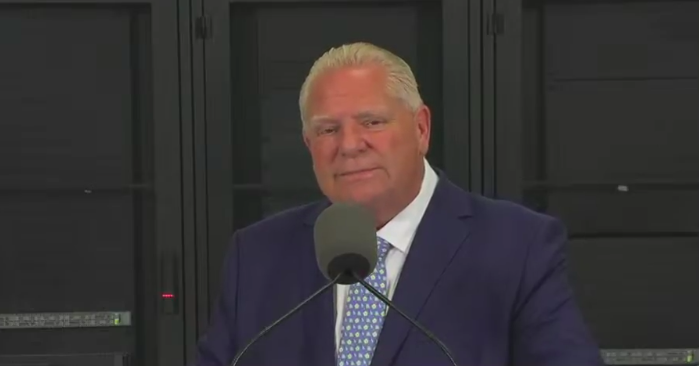
On August 13, Ontario Premier Doug Ford held a press conference in front of a wall of server racks at a Guelph data centre. "Today, I'm announcing Ontario is launching the Framework for our Data Centre Playbook," said Ford over the humming and whooshing of the machines.
The announcement comes as municipalities across Ontario are considering — and in Oakville's case, implementing — Interim Control Bylaws (ICBLs) that restrict new AI data centre developments until regulations are in place to protect residents from their well-known impacts.
The Province seems to be suggesting that this "Framework for a Playbook" constitutes those regulations.
However, no new legislation has been passed. Looking closely at the announcement, it's unclear what new rules are actually being proposed, apart from the Province saying they're "exploring" a new electricity rate class for large data centres.
Is the Ford government really committed to mitigating harms, or did they just want to announce something so that they can pretend ICBLs are no longer justified?
Local impacts
The proposal, to its credit, does at least acknowledge some common community concerns. That's progress compared with the Province's framing of Bill 40 last year, legislation they said would "allow the Minister of Energy and Mines to prioritize and approve connection requests from data centre projects that serve the province's economic interests" — with no mention of noise, water use, water pollution, grid strain, air quality, heat islands, land use, etc.
But even in this recent announcement, local impacts are literally just a footnote in the Province's slide deck. There is no clarity as to how impacts will be measured, what limits and rules will be enforced, or the enforcement mechanisms.
Which means it's way too early for communities to start packing up the pitchforks.
Ford also seemed to imply that existing rules are already enough to protect Ontarians, saying the Province will "only advance projects that meet Ontario's strict environmental standards" around water consumption and noise. (YouTube, timestamped)
This suggests that no new standards are actually coming.
And as Hamiltonians well know, the Province has been more than happy to look the other way when the steel industry flouts Ontario's existing "strict" rules on cancer-causing emissions.
The upshot: the "Framework for a Data Centre Playbook" does not represent a meaningful policy response from the Ford government.
Municipalities should not be shy about continuing to pass ICBLs, which perform two urgently needed functions: preventing data centre companies from rushing to build before regulation arrives, and, providing an insurance policy in case the Province enacts weak rules — or worse, no rules at all.
The Province's economic argument for AI data centres
In its slide deck (pdf), the Province uses future GDP gains as justification for a data centre buildout, saying:
"this Playbook is an early pillar and key enabler of the province’s AI strategy to leverage the economic opportunities AI adoption will bring, including generating $122 billion in economic growth and creating more than 17,000 new jobs every year."
Even if we accept these figures without question, the argument is confusing, since there's no direct relationship between a) AI adoption in Ontario, and b) the in-province build-out of AI data centres.
The cited numbers appear to be cribbed from a 2025 Deloitte analysis commissioned by the Vector Institute.
After contacting the Vector Institute, they kindly provided a copy of the full report. We'll break it down in a future piece.1
Promises to ratepayers
The cornerstone of the Playbook is a promise that AI data centres won't raise Ontarians' electricity bills. The slide deck says:
"data centres would pay their full cost of electricity costs and invest in necessary generation and transmission upgrades for their operations to maintain the reliability of the grid."
This sounds good, but on closer examination, the wording starts to get slippery.
At present, Ontario's Independent Electricity System Operator (IESO) already has a policy where, if new infrastructure only has a single beneficiary, then, according to a July 8 video presentation, that beneficiary will "usually carry the burden of most of that cost."
However, where upgrades or reinforcements can benefit other customers, the cost is "allocated across all ratepayers."
With this context, read the Province's statement again.
It's suddenly unclear if the Framework represents new policy, or if it's just a re-statement of existing rules.
New Generation
A major expense is the cost of building new power generation. The Province's own numbers show 10GW of data centre connection requests on a system with a peak load of 25GW.
Power for these new AI data centres will have to come from somewhere — either new grid-connected power plants, or "bring-your-own-power" (BYOP) generation built by the data centre company.
Power from the grid
As previously noted, under existing rules, ratepayers foot the bill for any new shared infrastructure. That means grid-connected power plants, as well as any transmission capacity upgrades that can potentially serve more than one customer.
What's more, the Ontario government continues to spend massively on nuclear, which is wildly expensive to build. Currently planned capital costs for nuclear generation could reach nearly $300 billion, and analysts say these could raise Ontarians' average residential bills by up to $456 per year, compared to building renewables instead.
Why do this? Well, nuclear is frequently pitched as being a stable base-load energy supply compared to renewables, especially for applications like large-scale data centres, which aim for as close to 100% uptime as possible.2
The Framework for a Playbook says the Province is "exploring" the creation of a new electricity rate class "for new data centres above a specific demand threshold (e.g., 1 MW)." If we accept nuclear advocates' argument about stable supply, then it seems reasonable to expect this new rate class to charge the per-kWh cost of nuclear generation, which is now roughly 3 times the cost of renewables.
In theory, this could allow the Ford government to make good on its promise that your electricity bill won't go up. But would AI data centre operators be willing to pay those rates?
Bring-Your-Own-Power
BYOP most often means on-site gas plants. Large-scale solar or wind farms require a lot of land, and nuclear takes at least 10 years to bring online (and, as previously mentioned, is extremely pricey).
In a BYOP scenario, the new power plants wouldn't show up on Ontarians' hydro bills, but there would still be a cost — in the form of reduced air quality, and increased climate impacts.
The Hamilton Example
When Hamiltonians raised concerns about grid strain at City Hall, a common refrain from data centre proponents (and their apparent proxies on Council) was that "the grid already has existing infrastructure and capacity" for their projects.
But a recent IESO report calls this into question.
Referring to the Steelport site on Hamilton's waterfront, the IESO describes the need for a new "Steelport TS" (transmission station) with a 351MW capacity.
Alectra Utilities was asked via email if this new infrastructure is being built for a single, dedicated customer, or if it will be considered a "shared network facility." An Alectra representative responded to the email, but did not provide an answer to the question.
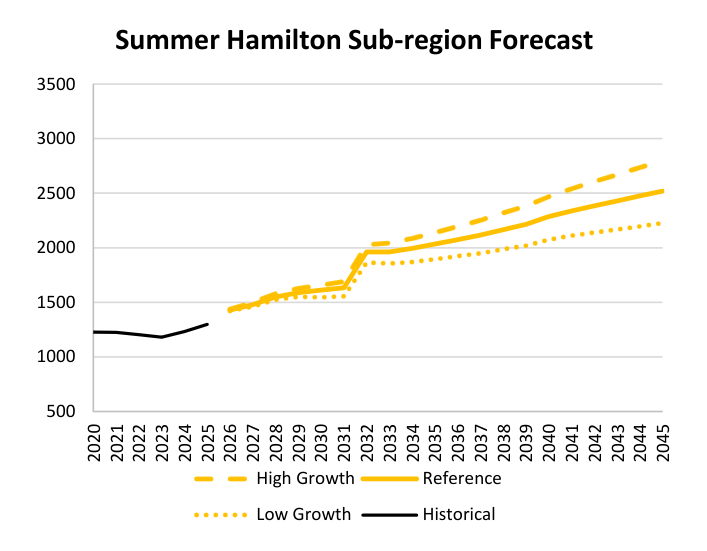
Additional grid reinforcements will be required for the Steelport project. The IESO's video presentation points to a "supply capacity need" of 351MW for specific circuits in Hamilton's bayfront industrial area, due to forecasted "thermal limitation" in 2032, when a large rise in demand is expected to kick in.
And yet, we're being told the capacity already exists on site.
Notably, the IESO's forecasting for the Hamilton area includes a range of future demand scenarios — factors such as economic boom and bust are apparently taken into consideration, for example — yet there appears to be very little uncertainty built in to the demand graph's "step change" from the Steelport project on pages 18 & 19.
However on July 10th, the size of Slate's grid connection request (#2025-846) was revised downward on the IESO's connection request page, from 400MW to 200MW. It's unclear if Slate modified their request in anticipation of a land severance approval, or if there was some other reason for the change.
Let's just hope we don't pay for a whole bunch of infrastructure before the request is revised even lower.
Notes
It's unclear if the Ontario government had permission to cite the report's numbers. The report's "Note to Reader" section contains the following:
"This analysis has been made only for the purpose stated and shall not be used for any other purpose. No party other than the Vector Institute is entitled to rely on this analysis for any purpose whatsoever and Deloitte accepts no responsibility, liability, or duty of care to any party other than the Vector Institute."
Feels like this could be a problem? back
Others point out that solar power, when combined with battery storage, is now a viable and much less expensive alternative to nuclear, at a price that's competitive with gas-fired generation. Nevertheless, the Province continues to press ahead with nuclear projects. back
Thanks for reading. If you enjoyed this piece, please share it with those you think will be interested. And if you have a news tip about a data centre project, send me an email or find me on Signal.