
The Wonder Valley Files, Part 2: Dinosaurs, past and present
Thanks to a cache of documents originally obtained through Freedom of Information requests by Canada's National Observer, Canadians have new insight into the Wonder Valley project.
However, the heavily redacted documents also raise as many questions as they answer. Read Part 1 of The Wonder Valley Files here.
Burning the rulebook
As summer temperatures creep higher year after year and Canadians find themselves routinely choking on wildfire smoke, the costs of our carbon emissions are starting to rack up in a tangible way.
Whether it's health impacts, the economic hits from cancelled events, closed patios, and lost work, or the price of relocating entire communities whose homes have been destroyed, the losses are no longer theoretical or "on the horizon" — they're here and now.
Meanwhile, the Alberta government has decided Kevin O'Leary (aka "Mr. Wonderful") does not need an environmental assessment for his proposed 7.5 GW gas-powered data centre, despite warnings it would singlehandedly set back the Province's emissions progress by 20 years.
To make matters worse, the Smith government has created new rules that limit data centre developers' options for energy use, effectively locking them in as the best customers for Alberta's rocky fossil fuel industry.
The federal government, for its part, facilitated this move with the Canada-Alberta Memorandum of Understanding, pausing the clean energy rules the Province would have otherwise had to follow.
Advisors to Prime Minister Carney have privately indicated they view large AI data centres as a means of boosting market-demand for liquid natural gas.
It's as if the extraction and burning of fossil fuels is no longer just a cheap and convenient — albeit destructive — means to an end, but has become an end in itself.
Mr. Wonderful's Top Ten(-ish) Reasons to locate in the GIG
Kyle Reiling, Executive Director at the Greenview Industrial Gateway (GIG) where the Alberta Wonder Valley project is slated to be built, appears to be aligned with that federal and provincial vision.
In late October, 2024, Reiling sent out an email with a draft communication titled "Mr. Wonderful's Top Ten Reasons to locate in the GIG."
The number one reason is a question, but does not end with a question mark:
"Did you know there is over 35.2 billion cubic meters of natural gas produced right next door to this land with an estimated 300 trillion cubic meters still sitting there."
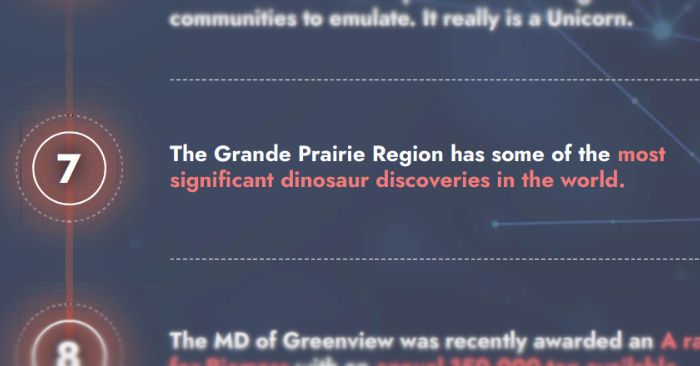
The remaining items might make someone wonder if this list should have ended after the first bullet. Number seven reads, simply, "the Grande Prairie Region has some of the most significant dinosaur discoveries in the world." One suspects O'Leary isn't deciding where to build data centres on that basis — but to be fair, the man wears two wristwatches at once, so anything's possible.
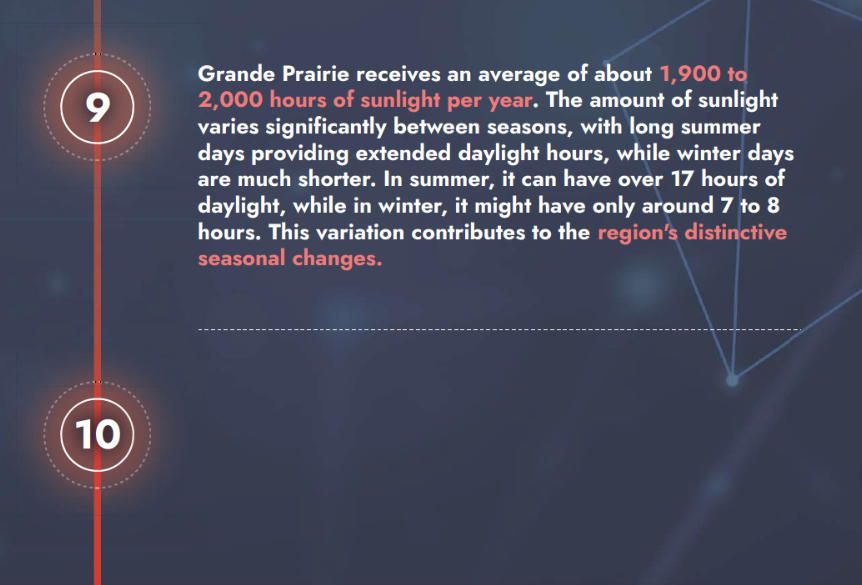
It could also be interesting to hear Mr. Wonderful chime in with his thoughts on reason number nine — a full paragraph that describes seasonal variations in the number of daylight hours in the region.
There is no tenth reason listed.
Hidden transactions
On paper, the Wonder Valley project is supposed to be about building the "world's largest data centre." But not only have Greenview's municipal staff been more excited about the prospect of burning gas — for them, this seems to be the whole point of the AI data centre push — the O'Leary team also appears to have priorities other than AI compute.
On October 7, 2024, just a couple of weeks prior to signing the letter of intent, there was a brief flurry of emails between Reiling and two municipal staffers, Martino Verhaeghe (Director of Planning and Economic Development) and Celine Chuppa (Planning and Development Officer).
The exchange begins with an urgent email from Reiling. He asks if cryptocurrency mining is considered an allowed use in the zoning amendment before Council the next day. It has just come to his attention, presumably via someone else in O'Leary's orbit, that crypto mining is "in their phase 1".
The three quickly coordinating to update the proposed text and the following day a bylaw amendment allowing "Data Processing Centre(s)" as a discretionary use was brought before Council.
Tacked on at the end of the land use definition is the following:
"This includes but is not limited to, digital currency processing, non-fungible tokens, and blockchain transactions."
Also attached to the online meeting agenda is a recommendation submitted by the Planning and Economic Development department, assuring councillors there are no "disadvantages" or "financial implications" related to passing the amendment.
Council passed the motion through first reading unanimously, 10–0, although it's not clear which councillors — if any — were aware of the immense scale of the project that would be announced just a few weeks later.
Ego boost
After the vote, Reiling was clearly feeling himself, boasting of the win in an email the next day.
The emotional high evidently had staying power.
A few weeks later, Reiling received an email from Site Selection Magazine, suggesting the gas-powered Wonder Valley project would be a "perfect fit" for a feature related to their "Energy Transition Investment" report (at the time, O'Leary was framing Wonder Valley as "green", with "full carbon capture" as part of the pitch.) Reiling responded to the inquiry by stating, rather bluntly, that news of the project "should be all of the front cover".
Readers can find the finished Wonder Valley article on page 40 of the March 2025 issue of Site Selection, the cover of which features Texas Governor Greg Abbott and then-DHS Secretary Kristi Noem.
Mirages
Once you take a peek behind the curtain, it's difficult to find a single aspect of the Wonder Valley project that lines up with what's being promoted.
The scale of the proposal is outlandish — only a handful of existing data centres are a twentieth of its supposed size — so the pitch has always seemed to be aimed more toward producing a reaction than a built product.
So far, this has borne out. Nearly two years after being announced, the comically gargantuan 7.5 GW gas-powered AI data centre hasn't yet broken ground. Something may eventually get built, or maybe it won't, but the project's true success won't be measured on that basis.
Wonder Valley's usefulness is in its completely hypothetical hyperscale: it's a lot easier for another company to come along and pitch a 100 MW behemoth (the energy consumption of a hundred thousand homes!) when the shadow of a fairy tale giant looms over everything.
Wonder Valley isn't real. But the impacts of that "small" 100MW data centre will be.
Thanks for reading. If you enjoyed this piece, please share it with those you think will be interested. And if you have a news tip about a data centre project, send me an email or find me on Signal.