
Who has your city's back in the data centre fight?
Rules must not be written by those who stand to gain at residents' expense
In BC, Alberta, Ontario, and across Canada, municipalities are rising to the challenge
As AI data centres proliferate, so does the backlash. It's not surprising. The facilities are the apex product of an investment frenzy spurred by many of the wealthiest, most powerful, and least scrupulous people on the planet. They cause widespread harm nearly everywhere they're built.
Much of the pushback is happening on the municipal level. This also isn't a shock; local leaders are in the best position to see and feel the impact of these new developments. Meanwhile upper levels of government both in Canada and worldwide seem only tuned in to inflated quarterly earnings statements and stock valuations, while ignoring regular people's material well-being.
As wealth-consolidation renders the social contract null and void, maintaining the appearance of economic success is a powerful motivator to charge even more zealously into the AI gold rush, regardless of municipalities' capacity to host the facilities, or communities' willingness to live next to them.
Snake oil
Some companies are responding to the widespread anger by introducing changes to how their data centres are built and operated. Many of these changes sound like improvements — at least on paper.
Municipal leaders, feeling pressure to ride a wave of development, but also recognizing their duty to protect residents, end up looking to the companies themselves for assurances that harms can be mitigated. In many cases, however, the "solutions" instead create new dangers, or simply shift burdens to a different location.
For municipalities at the forefront of creating the rules needed to meet this moment, it is crucial to listen to people who aren't just angling for a payday.
Let's take some lessons from the experience of cities around the world:
Melbourne is pushing back
In Melbourne, Australia, Lord Mayor Nicholas Reece is battling the state of Victoria, which touts itself as the country's "fastest growing market" in the AI sector. The state's PR materials are heavy on facilitating data centre growth, and light on reining in the industry's worst practices. They're "cutting red tape" and turning it into a red carpet.
Reece bluntly told Australia's ABC, "we don't have the proper regulatory frameworks in place ... [i]n our efforts to be smart cities, we don't want to cook the planet."
The language on the Invest Victoria website, by contrast, is more careful:
"Melbourne’s data centres meet international standards such as ISO 27001, combining efficiency, reliability, and security with sustainable energy and water practices, supporting scalable, cost-effective operations."
From this phrasing, one might expect ISO 27001 to refer to sustainability practices, or the measurement of environmental impact. It does not. It's a standard for information security systems. I've not been able to find any standard related to energy or water in the Invest Victoria material.
In June, first responders at Fire Rescue Victoria voiced concern over the "complex fire risk" of these facilities. They cite the danger of "thermal runaway" events (cascading chemical reactions that burn out of control) at a proposed data centre that will house a high concentration of lithium-ion batteries and diesel fuel.
The firefighters, speaking on condition of anonymity, emphasized the extreme toxicity of these types of fires.
The project has been fast-tracked by Victoria's Development Facilitation Program. It was approved in less than three months.
Phoenix: rising temperatures
The situation in Phoenix, Arizona is heating up in its own way. A study published in May found that data centres in the Phoenix area are causing downwind temperatures to rise by as much as 2.2 °C, in areas where summer temperatures "already routinely exceed 43 °C" and cooling requirements constitute "50% of household electricity use."
In Chandler, a city in the Greater Phoenix area, residents have been plagued by noise problems from data centres since 2014 — and in December 2025, Chandler City Council voted unanimously to reject a rezoning request that would have allowed a new data centre.
They did so despite a not-so-veiled threat from former US Senator Kyrsten Sinema that the Trump administration was ready to step in and ram the project through.
A Mayoral Alliance
Both Phoenix and Melbourne are among a group of 41 cities that recently published a whitepaper introducing The Global Urban Data Centres Pact, a blueprint for municipal regulatory frameworks.
The group is a subset of the 96-city C40 mayoral alliance, created with the goal of "powering global climate action through the collective strength of cities."
There's much to like about the Pact, and I think these mayors mean well. But it's also worth approaching with a healthy skepticism.
While the majority of C40's funders are the expected NGOs and large philanthropic organizations, backers also include Google, Uber, IBM, Amazon's "The Climate Pledge," and AI company Qlik. The whitepaper itself was developed "in partnership with Bloomberg Associates."
So it's worth asking: who might stand to benefit from this? Are the proposed policies earnest attempts at mitigating data centre impacts, or could some represent greenwashing, obfuscation, or even "solutions" that will only lead to new problems? And what does this say about data centre policy in general?
Energy generation
A major sticking point with data centres is the pollution associated with powering them — policies of both Canada's federal government and the Province of Alberta notwithstanding.
Here's the remedy, according to the C40's Pact:
"Meeting energy demand ... without extending the operation of existing, or reopening decommissioned fossil fuel plants. Committing to not using fossil fuels for on-site power and securing new and additional renewable energy generation and/or storage to meet, at a minimum, equivalent power demand and consumption."
Clearly this is better policy than building gas plants. And a promise to bring equivalent new renewables online is also great to see. But promises don't make good policy.
We don't have unlimited capacity to build and deploy renewables. The immense power requirements of the rapid data centre buildout have outpaced our ability to bring new renewables online, effectively extending the lifespan of existing fossil fuel infrastructure. What's more, data centre construction likely cannibalizes the very workforce that could be manufacturing, building, and installing such renewables.
Should these facilities be powered by renewables? Of course. But I'd also like to hear a Google/Amazon-funded org ask this: do we really need this many data centres?
Energy storage
Melbourne's firefighters were clear: these projects' battery storage systems can carry catastrophic risks.
Is it enough to simply trust that a developer won't cut corners? Do municipalities have people trained to properly evaluate these systems? Who pays to upgrade the local fire department's equipment?
Who bears the human cost when things go wrong?
Cooling systems
Here's the C40 Pact again:
"Reducing the environmental impact and reliance on shared resources by achieving best-in-class sustainability standards for emissions and water use (avoiding reliance on non-renewable water resources, including potable water) and actively capturing and using waste heat for community benefits"
New cooling systems — closed-loop, direct-to-chip, and so on — are meant to reduce the otherwise massive water consumption of AI data centres. Saving on water consumption is fine in and of itself. But these solutions create problems of their own.
Closed-loop systems use more energy. Energy generation itself often requires water for cooling, so water usage may simply be moved from the data centre to the data centre's power plant.
Serious concerns have been raised about the substances being deployed in these new cooling systems, in particular the use of PFAs gas (aka f-gas), a refrigerant and "forever chemical." Not only is it a potent greenhouse gas, it's also suspected of disrupting our reproductive systems.
Meta recently came under fire in Cheyenne, Wyoming, when an initial "fill-purge" cycle of a new closed-loop cooling system ended up discharging a rare and deadly bacterium into the city's wastewater system, which had to go "offline for months for cleaning." City officials only noticed the bacteria by chance, telling the Wyoming Tribune Eagle "[t]his isn't something we normally test for."
Here's something in C40's Pact that's very worth disentangling:
"... avoiding reliance on non-renewable water resources, including potable water."
It sounds good.
Data centres are routinely under fire for draining local groundwater. Groundwater is replenished via rainwater. But "rainwater harvesting" is framed as a more sustainable option by data centre proponents including Microsoft and Google.
To be fair, this takes pressure off of municipal drinking water systems, which may be the reason for the "potable water" language. But rainwater itself is no more renewable than groundwater. It's the same water, just in a different place.
Of note:
One of three business supporters of the C40's Global Urban Data Centres Pact is a company called Grundfos, which is in the water-pump business and sells systems for harvesting rainwater.
Waste heat recovery
From the C40 Pact:
"... and actively capturing and using waste heat for community benefits."
On the face of it, there's nothing wrong with this. But the devil, as always, is in the details.
It's worth pointing out that in addition to rainwater harvesting systems, Grundfos builds district heating infrastructure, which could use the waste heat captured from a data centre.
Compared with not doing anything at all, these initiatives increase energy efficiency, and can reduce carbon emissions if they replace fossil fuels for heating water or buildings. That's objectively good.
However, heat recovery isn't nearly so useful in the summer, which should weigh heavily in our decision-making as our warming planet increasingly necessitates cooling infrastructure. Plus, computers are effectively resistance heaters, which are remarkably inefficient versus modern alternatives.
An air-to-air heat pump can do heating and cooling, at nearly three times the efficiency of resistance heating. A geothermal heat pump is four to five times as efficient, and likewise can be used year-round. Are heat recovery systems preferable, then, to a geothermal system?
Of course, computers aren't only producing heat; they do other work too. But what happens in 5-10 years when the hardware becomes obsolete, and it's easier to build a new and better data centre somewhere else? What happens to the district heating system if/when the AI bubble pops? Is tying these particular systems to this particular industry a wise bet for municipalities?
Putting the cart before the horse
Another worrying possibility is that some folks are pushing for enormous data centres largely because waste heat recovery infrastructure might get grafted onto them.
Presenting to a room full of federal legislators and civil servants in May, McMaster University professor James S. Cotton — who studies thermal networks and is CEO of a company that builds heat recovery systems — showed a picture of a proposed hyperscale data centre site in Hamilton, saying the site "has the opportunity to heat every building you see there."
Later, at the presentation's 20-minute mark, there's a moment that I found pretty interesting, as someone who's been combing through documents for the last couple months to find out where data centres are being planned:
"So, we did this for the city of Burlington," says Cotton casually, "and, the local distribution company called me on April 23rd, and said you know what, we just found out that there's a new data centre opportunity in the centre of Burlington, do you think you could recover the heat from that? and I said yeah sure ... and they said can you give us a proposal, and give it to the data centre provider and I said yeah sure. So two days later my team sat down, we gave them a proposal ..."
At which point Cotton displays a map with the proposed location, which looks to be just southeast of Guelph Line and the QEW. It's the first I've heard of it.
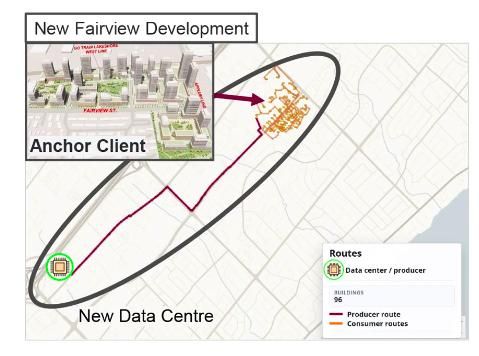
I'm curious to hear what the people of Burlington have to say about this, if and when they're eventually informed of the plan.
There are no easy solutions
As upper levels of government turn a blind eye toward harms while they court an unprecedented investment boom, and residents rightfully balk at having data centres built in their communities, municipalities end up in a difficult position.
With the massive scale of these projects comes the enormous responsibility to protect residents from their harms. But the supposed urgency of the buildout can drive municipal leadership to look for quick fixes. Unfortunately, many of these fixes are still new, barely tested, and/or are promoted by people with their own financial or professional interests in seeing them implemented.
With so much money sloshing around, it's difficult for anyone in (or adjacent to) the data centre industry to be objective. Municipal leaders must listen not only to those with something to gain, but also to the rest of us, who have so much to lose.
For those who do: residents will have your back.
Thanks for reading. I publish everything without paywalls. If you value my work, please consider buying me a coffee to help keep me going, and share this article with friends and family who you think will be interested. If you have a news tip about a data centre project, get in touch via email or on Signal.