
Who's lobbying for loopholes in Hamilton's proposed data centre moratorium?
Rumoured amendments could undermine the will of Hamilton residents

Note: For vital background and context regarding current data centre proposals in Hamilton Ontario, see the recent Blunder Valley posts from May 19 and June 9.
Where we are now:
On June 16, the City of Hamilton's Planning Committee voted unanimously, 9–0 (3 abstentions) to advance a motion to place a moratorium on new data centre development for up to a year — or until a Municipal Framework regulating data centre developments is created. This came after a second 8:30 am protest at City Hall, and dozens of residents and experts delegating in favour of the motion.
This means the motion will come before City Council on Wednesday, June 24. For those who would like to participate in the process, an explainer on how to take part is circulating, and StopTheDatacentre.ca is being frequently updated with the latest information about what councillors are saying, as well as links to media updates.
OF NOTE:
Blunder Valley is aware of credible reports that some Councillors may be looking to weaken the moratorium by creating regulatory carve-outs for one or more of the currently active proposals.
Shouldn't the rules apply to everyone?
Over the last couple of weeks, both the Digital Research Alliance of Canada(DRAC) and s2e Technologies have been scrambling to engage in a charm offensive, trying to assure residents — but mostly councillors — that their data centres definitely won't lead to the harms experienced virtually every other place AI data centres have been built.
Both groups frame their projects as research-focused, not-for-profit, green, and built following industry "best practices". Both DRAC and s2e have repeatedly implied that they should be exempt from any incoming regulations, while pointing to promises that are indistinguishable from investor and marketing materials.
S2e even sent in a pre-written loophole-amendment to Councillor Nann's motion in its letter to the Planning Committee, asking Council to exempt its proposed Frid St. data centre from the new rules residents are asking Council to write.
Having companies author their own regulatory regime rarely goes well for anyone but them. And there's little reason to believe this letter is anything other than self-serving.
S2e proposes an arbitrary threshold of 50 MW as the dividing line between a "small" or "large" data centre. There is no explanation for how this figure was derived.
This week the Planning Committee heard from Dr. Anne Pasek, a national expert on policies governing digital infrastructure, who described data centres "above about 10 MW in size" as unrepresentative of the "light" designation historically used for older, non-AI data centres. Similarly, Bloomberg's 2024 report on data centre grid strain defined "significant data centre activity" as anything over 10 MW.
Even s2e's "research-focused" claims invite questions when, for example, its CEO's own LinkedIn posts suggest that their data centre proposal for the old Spectator building represents an opportunity to work with "large enterprises working in the advanced AI space."
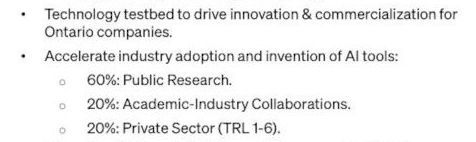
Likewise, reasonable people might question DRAC's pitch for "public research compute" and its "not-for-profit" ethos, considering that an April 8th presentation from the group stated that at least 20% of available compute would be for "academic-industry collaborations", with another 20% straight-up reserved for private sector use.
Read that again.
Suddenly, at least 40% of the project's $890 million of public funding looks like an enormous corporate handout.
Alternately, if Canadian corporations would be paying for compute at DRAC's data centre, then it's unlikely that DRAC would follow through on its promise to "adjust and plan its operations to address peak [energy grid] demand issues", despite what was written in a DRAC factsheet given to City Councillors earlier this month.
In terms of material effects on residents, details are scant as to what "best practices" actually entail.
Hamiltonians have been shown no codified standards, metrics, or otherwise measurable targets that these data centre projects are bound to meet when it comes to noise, heat-island effects, water and air pollution, grid strain, and so on.
Claims of "closed-loop" cooling systems, meant to lower a data centre's overall water footprint, invite further questions about PFAS (aka "forever chemicals") and other hazardous chemicals being discharged into waterways when such systems need periodic flushing.
Say we suppose that the many promises being made are genuine, shouldn't the developers welcome the chance to work alongside communities and municipal governments to build this new digital infrastructure responsibly?
What's true now might not be true later
Allowing some projects to be exempt from the rules carries several big risks.
Even data centres built with the best of intentions could, at some point down the line, face financial, industry, or even government pressure to expand, sell, or change the use-case of their facility.
Do we have any rules to prevent a relatively small data centre from continually expanding to hyperscale size? Is there anything to stop it from being sold off to a US tech giant? Putting clear rules in place allows the City to make sure that today's project with community buy-in doesn't end up transforming into tomorrow's noisy, pollution-spewing monstrosity.
When all else fails, Hamiltonians are being told, sorry, we just don't have the time to develop rules. If we boil it down, we're being told the need for these data centres is just too urgent.
But if AI infrastructure really is so vital and transformative, well, that's precisely why we should build it with forethought and care, with an eye to sustainability and longevity, along with proper communication, consultation, and buy-in from the communities who will be impacted by it for generations to come.
And yet, it looks like the City is feeling pressure not just from developers, but also from both upper levels of government to plow ahead with these projects, without guardrails, scrutiny, or even good information.
Hamilton must stand firm
The following is a brief peek into other machinations that may or may not directly result in Councillors or City Staff being pressured to approve particular data centres in Hamilton.
Mixed messages from the Province
Describing amendments to the Electricity Act contained in Bill 40 (passed in December 2025), the Province of Ontario says it "is taking action to prioritize electricity for data centres that support the province’s economic interests".
Business law firm McCarthy Tetrault notes that Bill 40 would grant the Minister of Energy and Mines "the ability to prioritize projects based on economic, strategic, security and local community benefits".
So it was definitely a surprise to read that a spokesperson for Stephen Lecce, Ontario's Minister of Energy and Mines, told CHCH News on June 16th that no data centre project will proceed unless it has community support.
This news might be doubly surprising to s2e Technologies, the developer hoping to partner with McMaster University to build a data centre in the old Hamilton Spectator building at 44 Frid St.
The company hired lobbying firm Capital Hill Group to discuss data centres with Lecce's office, with the latest update to their Ontario lobbyist registry records appearing as recently as June 9.
One possibility: the Province is feeling the heat over recent scandals, and is hoping to redirect people's concerns about data centres onto the federal government. City Hall should take notes.
Capital Hill Group, incidentally, has also lobbied the federal government on behalf of s2e, speaking about AI and data centres with employees at Innovation, Science and Economic Development Canada (ISED) on multiple occasions between July 2025 and February 2026. ISED is the federal government department responsible for distributing the $2.4 billion in AI infrastructure funding allocated in Budget 2025.
Other lobbying efforts
There are a couple of other notable entries in the federal lobbyist registry.
DRAC lobbied the Defence Department
DRAC lobbied the Department of Defence (DND) on 2025-10-06, shortly after naming Michael Schull as its new CEO on 2025-09-04.
The topic provided in the lobbying record gives little insight as to what was discussed: "Providing input to the Government of Canada’s Digital Research Infrastructure Strategy."
Nothing in DRAC's mission statement, mandate, vision statement, or list of guiding principles mentions anything to do with military research or applications.
(DRAC has also engaged extensively with ISED, among others. A meeting on 2026-03-25 that included three Hamilton-area MPs — along with two MPs from the Oakville-Milton area, and one from the riding of La Prairie-Atateken south of Montreal — suggests that DRAC may also be looking at those other two locations for new data centre builds.)
The federal government, for its part, is clearly hoping to sway public opinion in favour of the project. In the past few weeks, John-Paul Danko, MP for Hamilton West-Ancaster-Dundas, has posted multiple times on social media defending both Slate's hyperscale proposal and DRAC's proposal. It seems plausible the federal government is pushing for Council to introduce loophole amendments into the motion on June 24th.
McMaster University Lobbied the Defence Department
There are at least three occasions where McMaster University lobbied the Defence Department, on the topic of "Science & Technology Strategy — promotion of enhanced measures to increase research in science and technology" between 2025-10-15 and 2026-05-27. Many other universities are doing the same.
There are no records, however, to suggest that s2e technologies has lobbied the DND; their lobbying activity in 2026 has focused entirely on discussions with ISED.
A strange omission from McMaster University
In 2025, Hamilton Community Enterprises (HCE) released the results of its multi-year Energy Harvesting Feasibility Study. Multiple organizations participated in its creation, including a major contribution from McMaster University.
The study looked at the viability of expanding Hamilton's downtown District Heating system, and formed the basis for a partnership between HCE, DRAC, and Slate Asset Management.
A page on McMaster's Department of Engineering website notes that "[m]echanical engineering professor Jim Cotton and integrated energy systems research engineer Kelton Friedrich ... contributed significantly to the overall report submission."
But McMaster's contribution (pdf) to the study only lists Friedrich as an advisor; Cotton's name does not appear anywhere in the document.
James S. (Jim) Cotton, incidentally, is also the Founder and CEO of HARvEST Systems, a company that creates the very systems that could plausibly be used in the kind of "energy harvesting" infrastructure the study looks into.
It's unclear why his name was not included in McMaster's report provided to HCE.
What is clear:
Multiple levels of government are being lobbied by organizations working to advance projects that could benefit from loopholes in the data centre moratorium before Council next week. One hopes that our Councillors will side with their neighbours, and not cave in to the wishes of the powerful.
Thanks for reading. If you enjoyed this piece, please share it with friends and family who you think will be interested. And if you have a news tip about Steelport, DRAC, s2e or any other data centre project, send me an email or find me on Signal.