
Not Dead Yet: The Steelport Data Centre Fight Continues
Hamiltonians won an important battle, but the war is far from over.
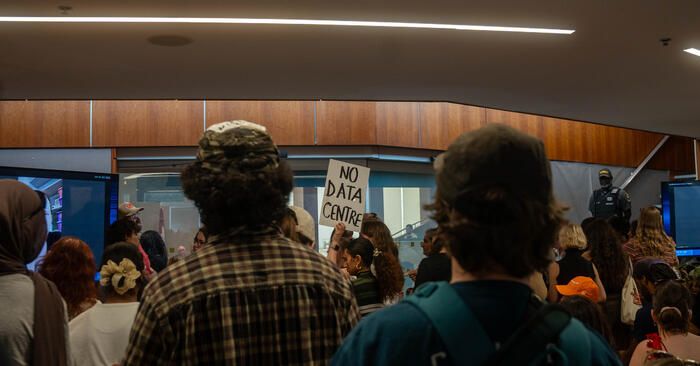
image credit: R. Wignall
Note: For vital background and context on the Steelport data centre(s), see the previous Blunder Valley post.
A crucial first step
On June 4th, Hamilton's Committee of Adjustment voted to deny a land severance application (pdf) by Slate Asset Management which, if approved, would have accelerated Slate's plans to build a hyperscale data centre by the waterfront.
The denial was in no small part due to the overwhelming response from Hamiltonians; the Committee member who moved to deny the application even cited the collective effort as the reason for the denial. Residents showed up in large numbers - thousands signed petitions, nearly 1800 sent written submissions to the Committee, and dozens spoke at the meeting itself, for nearly 8 hours in total.1
Perhaps most importantly, around 1000 people showed up physically outside City Hall at 8:30am on a Thursday - on just a few days' notice - making it absolutely clear that we will not allow those with money and power to unilaterally impose these data centres on our city.
But despite this win, the fight is far from over.
Slate will appeal this decision
This victory only represents a temporary reprieve. As of right now, there are still multiple viable paths for Slate to build a hyperscale data centre on the old Stelco lands on the waterfront.
First: Slate is likely to appeal the decision to the Ontario Land Tribunal (OTL). We will find out soon if that's the case; the appeal can be filed at any time within 20 days of the decision (see Ontario Planning Act s.45(10) and s.45(12)).
After that, there's no definite timeline on how long the appeals process could take. Some estimates seem to be in the range of a month or two. Others reckon the wait might be much longer. I'm not counting on the latter. When people in power really want things to move quickly, they usually have ways of greasing the wheels.
Worse: there's a good chance Slate would win an appeal. For one thing, the Committee of Adjustment's verbal explanation of their decision amounted to saying 'the application technically checked all the boxes, but just look at this crowd'. Plus, well, this is Doug Ford's Ontario we're talking about here, where the rules are often worth about as much as the paper they're printed on.2
In other words, this is all far from settled.
If Slate wins their appeal at the OTL: going forward, the severed parcel would only be subject to further scrutiny/approvals from city staff. Meaning, no more official means of input from the public, or from our elected representatives on Council. There are still a list of 16 conditions attached to the land severance, but many of these simply require Slate to submit reports and assurances on various issues. Beyond those conditions, staff would presumably just follow the existing zoning bylaws which, as Slate never gets tired of repeating, currently allow for hyperscale data centres.
Next Steps
First:
Hamilton's Ward 3 City Councillor Nrinder Nann has put forward a motion asking City staff to report back on factors that might inform a Municipal Framework around data centres in Hamilton. That report will be coming back on June 16th. We don't yet know exactly what staff will say, or what such a Framework might ultimately entail (size limits? a data centre moratorium? strict regulation around noise, water, heat?), but it is important to contact councillors before June 16th to share your concerns.
Implementing a Framework would, at the very least, create hurdles that data centre projects would need to clear before being approved. And in the best case scenario, it could mean a complete moratorium on data centre construction in this city.
Even that best case, however, wouldn't necessarily be an absolute victory for Hamilton residents - it would merely force higher levels of government to resort to more draconian tactics and override City Council, if they wanted to get these things built.
Second:
Municipal elections are coming at the end of October. We will need clarity from candidates running for Mayor and Council. StopTheDataCentre.ca has made a tracker that shows candidates' positions. We'll be keeping an eye on this, especially as the election nears. Who will support residents of Hamilton in this fight - and who will support the top-down imposition of these massive AI data centres?
(by the way - if you're in another municipality and want to make a tracker of your own: get in touch and we can get you connected with the right folks!)
That's the basic rundown on what's been happening. If you're desperate for some more juicy tidbits, here's...
Some More Juicy Tidbits
Lobbying
One thing that wasn't covered in the previous Steelport post is Slate Asset Management's lobbying of the federal government. Slate has spoken to multiple federal entities, including:
- the PMO
- Finance Canada
- Innovation, Science and Economic Development (ISED)
- Housing, Infrastructure and Communities (HICC)
And each of their lobbying activities lists the same discussion topic:
"Engage government decision-makers regarding Canada’s Sovereign AI Compute Strategy, including advancing Slate’s upcoming proposal to the Digital Research Alliance of Canada [DRAC], and opportunities to advance digital innovation and clean growth."
The word "including" is doing a lot of work here - it's now reasonable to assume they've been discussing other data centre plans, beyond just the DRAC project. This kind of phrasing reflects the sneaky way Slate has been trying to hoodwink well-meaning community organizations (such as Environment Hamilton, among others) by pitching them a nice little cute smol bean research facility - all while a hulking hyperscale monstrosity looms in the background. And to be clear: we don't actually have any actual specifics on the DRAC data centre!3
The PMO
It's not entirely clear why Slate is lobbying the Prime Minister's office directly. We do have indications that many decisions are coming from the top, however. Possibly of note: one of three investors in Slate's €425 million ($685m) debt refinancing round in 2024, a bank called Natixis, opened a Toronto office inside Brookfield Place in 2023, and in 2022 underwrote Brookfield's DCI Data Centers portfolio.
Finance Canada
There are question marks surrounding this lobbying as well. My best guess: it has something to do with the disbursement of whatever funding might come out of the other lobbying activities discussed below.
ISED
The reason for this lobbying seems more obvious: ISED is the department responsible for doling out funding related to the federal government's AI Sovereign Compute Infrastructure Program (AI SCIP).
Slate has partnered with the Digital Research Alliance of Canada (DRAC) and Hamilton Community Enterprises (HCE) on a proposal, submitted to ISED, to construct a "research" AI data centre just south of the land where Slate is still hoping to build a hyperscale facility. (See the earlier Steelport post on Blunder Valley for background on this.)
And while a federally-funded "sovereign AI research" facility may sound good on paper, there are serious questions that we should be asking.
For example: it was recently revealed that the federal government has been secretly signing contracts with US-based data analytics firm Palantir - a company closely aligned with the Trump administration, and who have been trying to become essential infrastructure for the UK's National Health System. Meanwhile, Canada's "AI champion", Cohere, is scrambling to distance itself from its past reported connections to Palantir.
To be clear: there's no direct evidence to suggest that companies like Palantir will get access to Canadians' sensitive personal data. But the links between the company and various levels of government appear quite strong: up until April 2026, David MacNaughton, former President of Palantir Canada, who in 2020 was found guilty of violating Canada's ethics laws for undisclosed lobbying on behalf of Palantir, was a member of the Prime Minister's Council for Canada-U.S. Relations.
HICC
This one is a little more ambiguous; there are two likely reasons that Slate would want to lobby HICC regarding "digital infrastructure". Both relate to the fact that the Canada Infrastructure Bank (CIB) reports to HICC.
First possibility: in Budget 2025, the federal government made changes that allow the CIB to invest in AI data centres. Slate may be seeking financing from the CIB to realize their hyperscale AI data centre ambitions.
Second possibility: Slate could be lobbying the HICC for funding to build out Hamilton's district heating system to use waste heat from either the DRAC data centre, or a hyperscale facility. This fits with their partnership with Hamilton Community Enterprises, who in 2024 commissioned an Energy Harvesting Study to examine the idea of pumping heat from Hamilton's industrial sector via hot water pipes into buildings in the downtown core.
District Heating and other "Green" initiatives
There's nothing wrong with the idea of a district heating system, on its face. Capturing waste heat and re-using it is fantastic in principle. But the devil, as always, is in the details of implementation.
For one thing, the Energy Harvesting Study based its emissions-reduction claims on a comparison with fossil-fuel heating. Which makes the numbers look great! But these days we have many other economical low-emission heating methods, including air-to-air heat pumps and geothermal heat pumps.
Compared to resistance heating (e.g. an electric baseboard heater), these heat pump systems are 300% to 400% efficient - meaning that per unit of electricity used, they heat a building 3x to 4x as much as resistance heating does.
Computers are, insofar as they generate heat, resistance heaters. So here's what we should be asking: is this inefficient heat source, also known as an AI data centre, creating enough benefit - and causing a low enough level of harm - to justify the massive infrastructure expense involved in such a system? Especially compared to simply going geothermal, which uses a fraction of the energy? Do we want to run headlong toward inextricably linking our downtown buildings' heating systems to an industry that isn't providing much social or economic benefit?
Do these AI data centres create many jobs? No. Do they have a long list of environmental impacts? Yes. Have they caused electricity prices to rise everywhere they get built? Yes. Are AI data centres a financial bubble that could pop any moment and leave our downtown buildings scrambling to find a new heat source? It seems risky!
Besides: where does all this waste heat go in the summer, when those same buildings need cooling? A geothermal system can do cooling and heating; a waste-heat-capture system does not.
(For more on this topic, see Dr. Anne Pasek's excellent talk titled "Data Centres in Ruins: What Comes After the AI Bubble Pops?").
Like a lot of other development - the AI data centre bubble is the perfect example of this - there's a bias toward "innovation" without ever considering if that innovation truly represents progress. You also have to wonder if HCE, in this instance, is like a hammer looking for a nail, in their quest to expand the district heating system.
HCE's Annual General Meeting is on June 23, 2026. I'm hoping that some City Council members will start asking some difficult questions about HCE's partnership with Slate Asset Management, and take a closer look at both the benefits and the drawbacks of initiatives like these.
Thanks for reading. If you enjoyed this piece, please share it with friends and family who you think will be interested. And if you have a news tip about Steelport or any other data centre project, send me an email or find me on Signal.
Notes
1. To give a sense of what this Committee might ordinarily deal with: a separate agena item was requesting that "an eave or gutter ... may encroach into any required yard to a maximum of 0.5 metres instead of the maximum permitted 0.45 metres", as part of a property owner seeking permission to build a two-storey backyard housing unit and garage. In fact, there was a surreal moment early in the day when someone called in to present their verbal concerns to the Committee of Adjustment regarding this exact agenda item, clearly not knowing what the situation looked like inside City Hall. back
2. There is a tiny sliver of hope here: a number of the written and verbal comments submitted to the C of A seemed to make cogent and compelling arguments for denial based on facts around the land severance application itself. But I'm not a lawyer, and it feels like this is a long shot, especially in the face of a federal and provincial government that seem determined to ram through favoured projects regardless of opposition or any social & environmental consequences. back
3. To be clear: the "small" facility being proposed by DRAC is still likely to draw enough power for well over 10,000 homes. But we don't know the exact number. Because although the organization has loads of time to assure the CBC that everything will be low-impact, I've directly asked DRAC on more than one occasion for information about power draw, water consumption and discharge, cooling type, and specific metrics and standards for noise and heat island effect mitigation, and thus far have only received vague non-answers as a response. back