
A fresh coat of green paint — Part 2: HCE's Energy Harvesting Study
Hypothetical $250m project may require additional scrutiny

image credit: United Soybean Board, used under CC-BY-4.0 license
This is part two of a two-part series. For part one, see here(https://blundervalley.ca/blog/hamilton-green-paint-pt-1-mantle/)
From 2023 to 2024, Hamilton Community Enterprises (HCE), a City-owned energy and telecom company, looked into expanding their existing district energy system. The resulting document, called the Energy Harvesting Feasibility Study (also referred to as the Energy Harvesting Study), examines the potential for capturing heat from industrial processes in the Bayfront area and piping it to buildings for space and water heating.
Today, natural gas powered boilers generate and distribute heat and hot water to multiple addresses in downtown Hamilton, including City Hall and the Art Gallery of Hamilton. HCE was created in 2002 to construct and run this district energy system, part of an effort by the Province to wind down coal-fired power generation across Ontario.
District energy networks are common in cities worldwide, and proponents cite a number of advantages. For buildings connected to them, equipment and maintenance costs are comparatively low. They can also increase overall system efficiency.
Importantly, these networks make it much easier to transition a large number of customers all at once from one fuel type to another (say, natural gas to geothermal) because only one central heat source needs to be changed for dozens or even hundreds of buildings.
The Energy Harvesting Feasibility Study produced by HCE envisions switching from natural gas generation to primarily "waste heat" recovery. In theory, this could mostly decarbonize Hamilton's district energy system — a worthwhile goal to be sure.
Does the study stand up to scrutiny? Let's dig in.
Not all heat sources are created equal
Here's the question that regular readers of this site will be asking: are data centres a good fit for this?
The study discusses the differences in heat quality of various processes. Industrial furnaces might provide heat at temperatures greater than 100°C. Data centres, on the other hand, are in the sub-50° range.
Reports from early phases of the study point to multiple downsides of using low-grade heat, like that from data centres, in a district energy network:
Lower-temperature sources are inefficient and costly compared to higher-grade heat sources, as they require industrial-scale heat pumps to boost the temperature to levels suitable for distribution.
Likewise, the business case is markedly worse with low-temperature heat sources — whereas in the high-temperature scenario, expected financial returns for both the operator and waste heat suppliers "increased dramatically", making the project "very attractive for investment."
HCE's study describes "inherent risks" in relying on new developments when building or expanding an district energy system. This is echoed by research in Renewable and Sustainable Energy Reviews, which argues this risk is especially relevant in the case of data centres, which are "driven by rapid technological advancements and market demands ... whereas district heating systems have life spans of 40–50 years."
In other words: the experts say it's risky to tie long-term public infrastructure to a potentially short-term industry.
The study estimates public investment in this project would total roughly $250 million over the first ten years.
Vibe Shift
Despite the risks and concerns raised early on, a shift ultimately occurs: later phases of the study only end up considering lower-temperature heat sources and/or new developments.
Why?
For what it's worth, HCE's answer is on page 55: ArcelorMittal Dofasco (the most obvious high-temperature heat source) "was concurrently conducting an internal energy review and could not confirm potential sources and their availability."
One might think the folks running the study would simply wait for Dofasco's review to complete, rather than closing off apparently viable paths forward for a project involving up to a quarter-billion dollars of Hamiltonians' money.
The good news is, we should be able to get insight as to why they didn't wait — page 22 of the study claims the minutes from the quarterly Steering Committee meetings are "available on request".
The bad news, however, is that Blunder Valley has requested these meeting minutes via multiple email and phone messages, beginning October 15. A representative from HCE replied to a fourth attempt on November 16, writing that it would take "a bit of time, potentially a couple of weeks" to provide the documents, citing "a requirement to notify the other study participants of the request." This piece will be updated when the meeting minutes are ultimately provided.
Notably, the Steering Committee consists entirely of entities that could stand to gain financially from a project like this moving forward: HCE, Slate Asset Management, Enbridge Gas, ArcelorMittal Dofasco, Hamilton Chamber of Commerce, and the Hamilton-Oshawa Port Authority. There are no representatives from the City of Hamilton, local citizens' groups, or public-interest organizations.
Who benefits from this?
There are other examples of data centres being used as heat suppliers in district energy systems. But the data centre operator, according to reporting by The Energy Mix, isn't necessarily "doing this out of the goodness of its heart."
For starters, the heat is sold for a price. A Microsoft facility set to sell heat to 100,000 homes in Espoo, Finland refused to disclose contract details to Bloomberg. And in Hamilton, HCE's study assumes that district heat would be sold to consumers at a price equivalent to natural gas heating, which may not be competitive compared to modern heat pump options. But the study specifically calls out the extra revenue from heat recovery as being attractive to "high-intensity energy users" like data centres.
The climate benefits are also frequently overstated. Research suggests data centres worldwide consume approx 240–340TWh of electricity. Yet even though 100% of that energy ultimately manifests as heat, the recoverable heat is just a fraction of this — around 35–85 TWh. Meanwhile, data centres are driving a resurgence in gas power generation, which could explain Enbridge's membership on the study's Steering Committee. And as a Norwegian parliamentarian told Bloomberg, even where data centres are on a relatively clean grid, they "consume power we could use for other things" — which supports demand for fossil fuels.
Municipal tax rebates
The City of Hamilton has implemented a serious tax rebate sweetener for industries such as data centres looking to connect to a waste heat recovery system.
It works as follows. Before brownfield sites are redeveloped, the land will need remediation, e.g., removal of toxic soil. Once the land is redeveloped, the property tax bill goes up to reflect the new value. The ERASE Program is designed to defray the remediation cost by providing a tax rebate to cover the cost of that cleanup.
This makes sense in cases where contaminated land has been sitting idle for long periods — assuming the new land use creates jobs, beautifies the city, and won't simply have other kinds of environmental impacts. The program provides a rebate of up to 80% of the additional tax bill for 10 years.
And that's without the sweetener: if the new building's developer simply creates the hookups for district heating infrastructure to be added at some point in the future, the potential rebate rises to 100% of the additional tax bill for 13 years. That benefits the landowner as well as HCE — but if the project is a hyperscale data centre, is it a net benefit for Hamiltonians?
The McMaster Connection
As previously reported by Blunder Valley, there are some questions surrounding a particular McMaster University professor's level of involvement in the study.
On McMaster's Department of Engineering site, a webpage notes that "[m]echanical engineering professor Jim Cotton and integrated energy systems research engineer Kelton Friedrich ... contributed significantly to the overall report submission."
Yet while Friedrich's name appears on the study, James Cotton's does not. Cotton is the founder and CEO of a company called HARvEST Systems, which designs and creates the kind of "energy harvesting" equipment that could, in theory, be used in systems like the one proposed in the study. It's unclear why his name was not included.
One might chalk this all up as simply an error on McMaster's website. However, it turns out this is not the only time Cotton has been described as a key figure in the Energy Harvesting Study. A February 2026 video on the McMaster Alumni YouTube channel introduces the professor as having led the project. Cotton does not appear to react, and does not object to the claim.
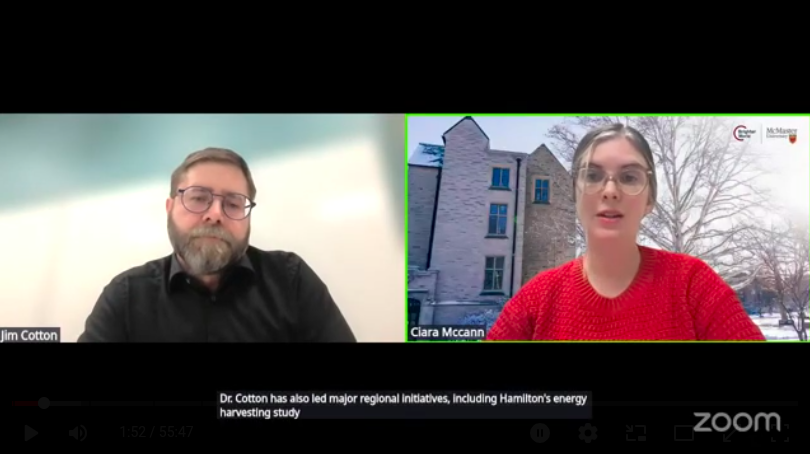
McMaster University has been contacted multiple times to clarify their research ethics rules, but has not provided answers.
Thanks for reading. If you enjoyed this piece, please share it with those you think will be interested. And if you have a news tip about a data centre project, send me an email or find me on Signal.